A-subunit (C-20, Santa Cruz Biotechnology) antibodies and
developed as described above.
later. The cells were then incubated for 48 h and harvested by
trypsinization, washed once with PBS, and resuspended in 0.5
ml of PBS. The cell suspension was then added to 4.5 ml of 70%
ethanol and incubated on ice for 2 h. Cells were collected by
centrifugation, washed once with PBS, and suspended in 1 ml of
propidium iodide/Triton X-100 staining solution with RNase
(0.1% Triton X-100, 0.2 mg/ml DNase-free RNase, and 10
g/ml propidium iodide in PBS). The DNA content of 10,000
cells was determined using a BD Biosciences FACScan flow
cytometer and FlowJo software. Single cells were gated away
from clumped cells using an FL3 width versus FL3 height dot
plot, and the DNA content of individual cells was plotted as FL3
area versus cell number.
of common results obtained in at least three independent
experiments.
the human Cdc6 protein as bait (17) and subsequently shown to
be a fragment of a longer cDNA (27). A full-length human PR70
cDNA was constructed by ligating expressed sequence tag
BM54432 to the PR48 cDNA using an internal NcoI restriction
site. The predicted open reading frame of the PR70 cDNA
encodes a protein with a calculated molecular mass of 65.1-kDa
and corresponds to the longer transcript (variant 1) of the
PPP2R3B
mouse PR59 members of the PPP2R3 gene family, but more
distantly related to the G5PR protein (supplemental Table S1
revealed a highly conserved central domain, termed the R3
domain, that contains two conserved EF-hand calcium binding
motifs previously identified in PR72 (27). Rabbit antisera were
raised against a peptide corresponding to the unique C termi-
nus of PR70 and affinity purified on a peptide column. The
purified antibodies recognized a protein band of M
antibody was greatly reduced in cells treated with two different
siRNAs corresponding to sequences within PR70 but not with
control siRNA (supplemental Fig. S2).
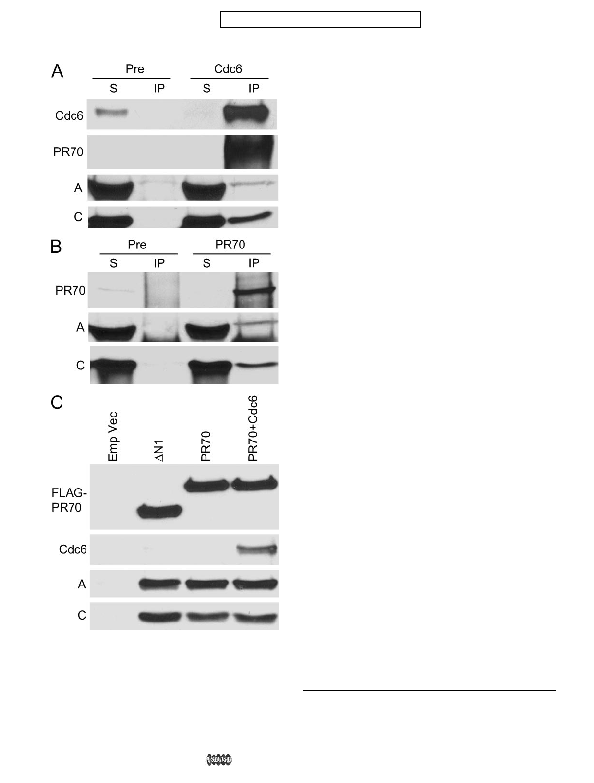
ies. Immunoprecipitation of Cdc6 co-precipitated a diffuse
protein band that migrated at the position of PR70 that was not
tated from exponentially growing HeLa cells using a polyclonal antiserum
specific for Cdc6 (Cdc6) or pre-immune serum (Pre). The immunoprecipitates
and supernatant fractions were analyzed by immunoblotting using anti-Cdc6
(Cdc6), anti-PR70, anti-A-subunit, or anti-C-subunit antibodies. B, PR70 was
immunoprecipitated from HeLa cells using an anti-peptide antiserum against
PR70 (PR70) or pre-immune serum (Pre). The immunoprecipitates (IP) or the
supernatants remaining after immunoprecipitation (S) were resolved by SDS-
PAGE and analyzed by immunoblotting with anti-PR70 (PR70), anti-A-subunit
(A), and anti-C-subunit (C) antibodies as indicated on the left. C, HeLa cells
were transiently transfected with empty expression vector (Emp Vec), plas-
mids expressing the FLAG-PR70
were harvested after 24 h, and lysates were immunoprecipitated with anti-
FLAG antibodies. Immunoprecipitated proteins were resolved by SDS-PAGE
and immunoblotted with anti-FLAG (FLAG-PR70), anti-Cdc6, anti-A-subunit,
and anti-C-subunit antibodies as indicated on the left.